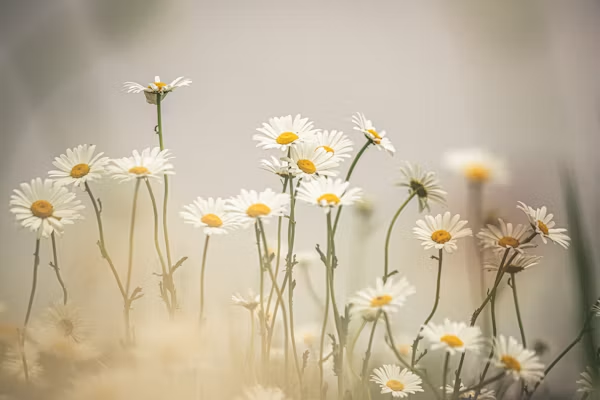
The Daisy: History, Varieties, and Botanical Significance
The term "daisy" common to many species in the family Asteraceae primarily refers to Bellis perennis (the common English daisy) and Leucanthemum vulgare (the oxeye daisy). Celebrated for its modest, iconic structure of white rays surrounding a golden center, the daisy is a global symbol of innocence, simplicity, and natural resilience.
1. History and Etymology
Etymological Roots: The word "daisy" originates from the Old English dægesēage, meaning "day's eye." This name reflects the plant's habit of opening its ray florets at dawn to expose the central yellow disc and closing them tightly at dusk.
Ancient Folklore & Herbalism: Native to western, central, and northern Europe, daisies have been cultivated and utilized for thousands of years. In Norse mythology, the daisy was designated as the sacred flower of Freya, the goddess of love, beauty, and fertility. Ancient Roman soldiers harvested wild daisies to extract juice for soaking bandages, applying its mild astringent and anti-inflammatory properties to battlefield wounds.
Cultural Symbolism: Throughout medieval Europe, the daisy was praised in literature and poetry as an emblem of purity and unpretentious charm. It inspired popular tradition, such as the classic fortune-telling pastime of plucking petals ("he loves me, he loves me not").
2. How the Daisy Emerges & Grows
Composite Flower Head (Capitulum): What appears to be a single single bloom is actually an optical composite structure called a pseudanthium (false flower). It consists of two distinct floret types:
Ray Florets: The outer, petal-like structures (typically white, pink, or yellow) that are sterile or female, evolved specifically to attract pollinators.
Disc Florets: The densely packed central yellow core, composed of dozens to hundreds of tiny, fertile, tubular flowers that produce nectar and seeds.
Growth and Resilience: Daisies grow from creeping underground rhizomes or seeds. They adapt exceptionally well to various soil conditions, forming dense basal rosettes of leaves that survive close mowing and grazing.
Pollination: Highly accessible to a broad spectrum of pollinators, including bees, flies, butterflies, and beetles, each fertile disc floret produces an achene (a small, single-seeded dry fruit) that disperses easily via wind or animal contact.
3. Key Categories and Varieties
While Bellis perennis is the true lawn daisy, several distantly related members of Asteraceae are commercially cultivated under the common name:
English Daisy (Bellis perennis): The classic wild lawn flower, featuring small, delicate heads. Cultivated garden varieties include double-bloomed cultivars like 'Rominette' with fluffy, cushion-like pink and red heads.
Shasta Daisy (Leucanthemum × superbum): A popular garden hybrid bred by Luther Burbank in 1890. Known for its large, sturdy, pure-white blooms on tall stems—ideal for borders and cut arrangements.
Gerbera Daisy (Gerbera jamesonii): Native to South Africa, these large, vividly colored daisies feature intense shades of red, orange, yellow, and deep pink, making them a staple in commercial floristry.
Marguerite Daisy (Argyranthemum frutescens): A bushy, shrub-like plant native to the Canary Islands, widely grown in containers for its abundant, continuous summer blooms.
4. Global Locations and Ideal Conditions
Distribution: Native throughout Europe and temperate Asia, daisies have naturalized in North America, South America, Australia, and New Zealand. Due to their vigorous growth, some species (like the oxeye daisy) are considered invasive weeds in managed pastures.
Cultivation Needs: Daisies are remarkably adaptable, preferring full sun to light partial shade and well-draining soil. They are low-maintenance, drought-tolerant once established, and thrive in cooler to moderate temperate zones.