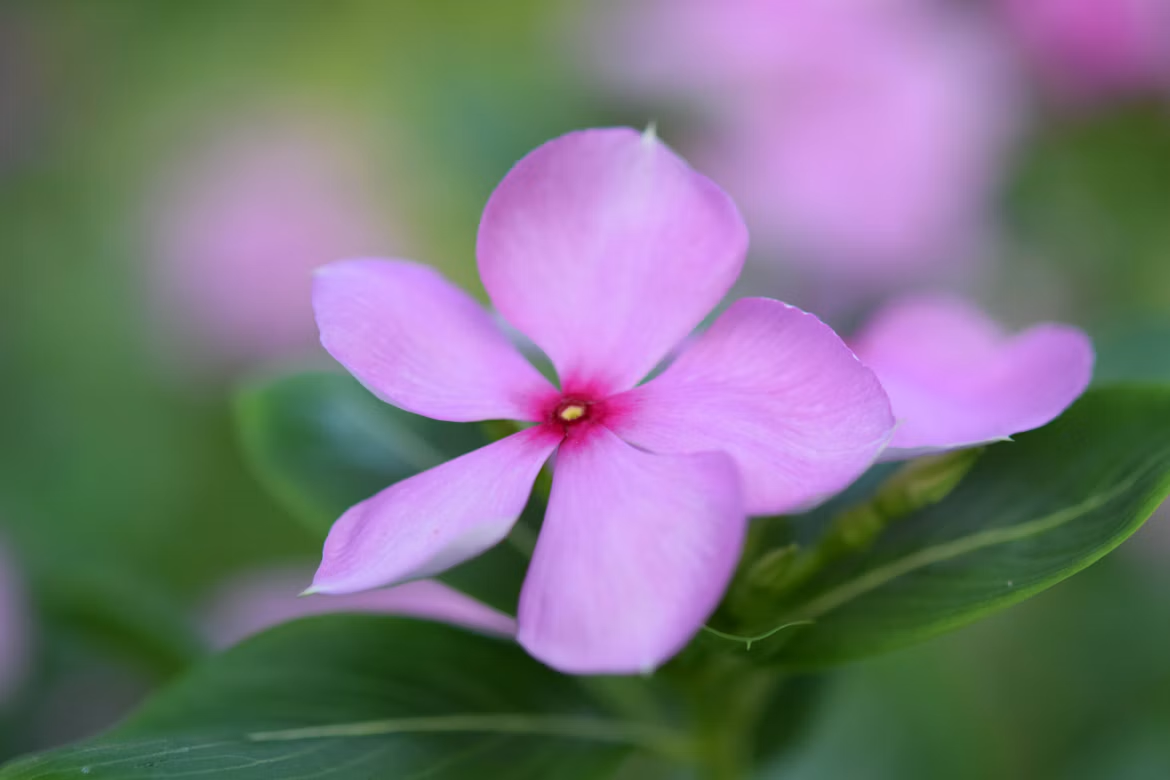
Madagascar Periwinkle
The Madagascar Periwinkle: History, Biology, and Medical Legacy
The Madagascar periwinkle (Catharanthus roseus, formerly classified as Vinca rosea), widely known across South Asia as Nayantara or Sadabahar ("always blooming"), is an evergreen subshrub in the dogbane family, Apocynaceae. Celebrated for its continuous, year-round display of five-lobed blossoms and extraordinary heat tolerance, it holds a legendary status in modern medicine as the botanical source of life-saving chemotherapy drugs.
1. History and Cultural Significance
Endemic Roots in Madagascar: Despite its pantropical presence today, Catharanthus roseus is endemic to the dry coastal regions and open woodlands of Madagascar. Its genus name derives from the Greek katharos ("pure") and anthos ("flower"), translating to "pure flower".
Traditional Medicine Across Continents: As European explorers and traders carried the resilient plant across the tropics in the 18th century, local healers independently incorporated it into folk medicine. In Madagascar, India, the Philippines, and Jamaica, leaf decoctions were traditionally brewed to treat diabetes, high blood pressure, wasp stings, and eye infections.
Breakthrough in Oncology: In the 1950s, Canadian researchers Robert Noble and Charles Beer—investigating a Jamaican folk tea reputed to treat diabetes—discovered that extracts from the plant dramatically lowered white blood cell counts. This accidental discovery led to the isolation of vincristine and vinblastine, revolutionizing the treatment of childhood leukemia and Hodgkin's lymphoma.
2. Botanical Structure & Alkaloid Chemistry
Growth Habit & Foliage: Growing up to 3 feet (1 meter) tall, the plant forms a neat, woody-based subshrub with glossy, hairless, oval-to-oblong green leaves featuring a distinct pale central midrib arranged in opposite pairs.
Pinwheel Floral Anatomy: The blossoms consist of a slender basal tube (2.5–3 cm long) opening flat into five overlapping, pinwheel-like petal lobes. Wild forms display pale pink petals with a dark red eye or pure white petals, while seed pods develop as paired, slender follicles containing numerous small black seeds.
Terpenoid Indole Alkaloids: The plant synthesizes over 120 distinct alkaloids as a bitter chemical defense against grazing herbivores. Because these potent compounds are toxic if ingested raw, all parts of the plant are poisonous to humans and pets outside of controlled pharmaceutical extraction.
3. Key Varieties and Horticultural Groups
While commonly referred to as "Vinca" in the nursery trade, Catharanthus roseus is botanically distinct from temperate trailing periwinkles (Vinca minor and Vinca major). Commercial breeders have developed numerous compact, disease-resistant series:
'Cora' & 'Cora XDR' Series: Bred specifically for high resistance to Phytophthora aerial blight, offering vigorous mounding growth and large flowers in shades of white, apricot, magenta, punch, and deep violet.
'Pacifica' Series: Known for early, uniform blooming and intense heat tolerance, producing large overlapping petals across an extensive color palette.
'Cooler' Series (e.g., 'Grape Cooler', 'Peppermint Cooler'): Developed to tolerate cooler spring temperatures and higher humidity without yellowing or stunting.
'Mediterranean' Series: Trailing, cascading cultivars bred specifically for hanging baskets, window boxes, and spilling over garden walls.
4. Global Locations and Ideal Conditions
Distribution: Naturalized across tropical and subtropical regions worldwide—including Bangladesh, India, Southeast Asia, Australia, and the southern United States—where it blooms continuously throughout all twelve months. In temperate zones, it is cultivated as a reliable warm-season summer annual.
Climate & Light Requirements: The Madagascar periwinkle thrives in hot, sunny conditions, requiring full sun exposure (at least 6 to 8 hours of direct sunlight daily) for compact growth and prolific flowering.
Soil & Moisture Resilience: Exceptionally drought-tolerant and adaptable to poor, sandy soils once established, it strictly requires well-draining soil. Overwatering or cool, soggy soil rapidly triggers fungal stem and root rot.