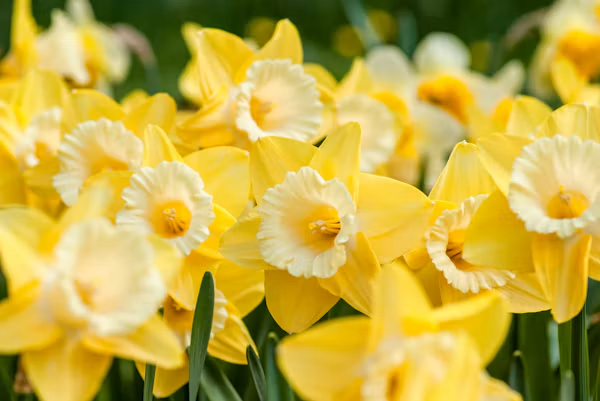
The Daffodil: History, Biology, and Botanical Legacy
The daffodil (Narcissus) is a genus of predominantly spring-flowering perennial plants in the amaryllis family, Amaryllidaceae. Celebrated for its bright trumpets, resilience, and early spring emergence, the daffodil stands as a global symbol of rebirth, new beginnings, and hope.
1. History and Cultural Significance
1. History and Cultural Significance
Mediterranean Origins: Daffodils are native to southern Europe, North Africa, and the western Mediterranean region, with the Iberian Peninsula hosting the greatest concentration of wild species. Ancient Greeks and Romans cultivated daffodils for their medicinal properties and beauty.
Mythological Roots: The botanical name Narcissus stems from Greek mythology. According to legend, a handsome youth named Narcissus fell so deeply in love with his own reflection in a pool of water that he pined away until he was transformed into the flower that bears his name.
Cultural Symbolism & Cancer Awareness: In European folklore, the daffodil heralds the end of winter. In Wales, it is the national flower, traditionally worn on St. David's Day (March 1st). Universally, the bright yellow blossom has been adopted by cancer charities worldwide (such as the American Cancer Society and Marie Curie in the UK) as an emblem of hope and courage in the fight against disease.
2. Botanical Anatomy & Toxic Defense
The Corona and Perianth: The distinctive structure of a daffodil bloom consists of a central cup- or trumpet-like structure called the corona, surrounded by a ring of six outer petal-like segments known as the perianth (composed of three true petals and three sepals).
True Bulb Mechanics: Daffodils grow from underground tunicate bulbs containing stored energy. They require a cold winter chilling period (vernalization) to trigger stem elongation and flower development in early spring.
Alkaloid Toxicity & Pest Resistance: All parts of the daffodil—especially the bulb—contain toxic alkaloid compounds, primarily lycorine and calcium oxalate crystals (raphides). This natural chemical defense makes daffodils completely unpalatable to deer, rabbits, squirrels, and rodents, making them exceptionally reliable, low-maintenance perennials in naturalized gardens.
3. Key Divisions and Botanical Classifications
The Royal Horticultural Society (RHS) and international registrars organize the tens of thousands of registered daffodil cultivars into 13 official divisions based on floral structure and proportions:
Trumpet Daffodils (Division 1): The classic form where the central cup (corona) is as long as or longer than the outer petals (perianth).
Large-Cupped & Small-Cupped (Divisions 2 & 3): Variations where the corona measures between one-third to over half the length of the perianth petals.
Double Daffodils (Division 4): Features multi-layered coronas or perianths, creating dense, peony-like double blooms.
Jonquilla & Tazetta (Divisions 7 & 8): Characterized by multiple small, highly fragrant blossoms clustered on a single stem. Tazetta varieties include the popular indoor-forced Paperwhite (Narcissus papyraceus).
Poet’s Daffodil (Division 9): Narcissus poeticus features pure white petals with a tiny, flattened yellow cup rimmed in vivid red, possessing a deep, spicy aroma.
4. Global Locations and Ideal Conditions
Climatic Requirements: Daffodils thrive in temperate zones with cold winters and cool, moist springs. They require full sun to light partial shade (at least 6 hours of daily sunlight) during their active growing and flowering season.
Soil & Maintenance: Prefers moist, well-draining soil. High moisture during the spring growth phase is essential, but summer soil should remain relatively dry to prevent bulb rot while the plant is dormant.
Naturalizing: Daffodils multiply effortlessly over time via bulb offsets (daughter bulbs), forming vast, naturalized drift colonies across open woodlands, parks, and grassy hillsides across Europe, North America, Australia, and New Zealand.