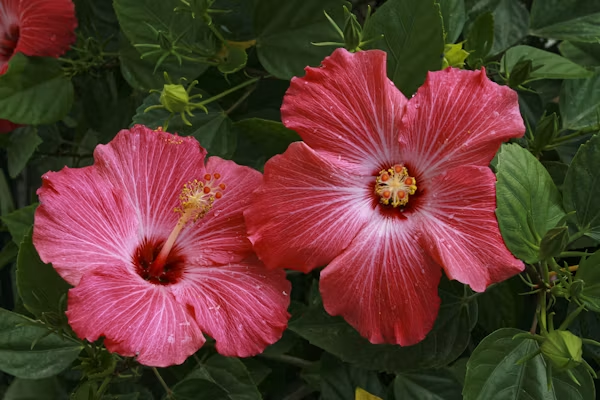
The Hibiscus: History, Biology, and Tropical Legacy
The hibiscus (Hibiscus) is a large genus of hundreds of species of flowering plants in the mallow family, Malvaceae. Renowned for their oversized, showy blossoms and striking central staminal columns, hibiscus plants are celebrated across warm temperate, subtropical, and tropical regions worldwide for ornamental gardening, herbal teas, traditional medicine, and textile fibers.
1. History and Cultural Significance
Tropical Asian and Pacific Origins: While species within the genus are native to warm regions across Asia, Africa, and the Americas, Hibiscus rosa-sinensis (the tropical hibiscus) is believed to have originated in tropical Asia, particularly south China and Vanuatu.
National and Cultural Emblems:
Malaysia: Hibiscus rosa-sinensis (known locally as Bunga Raya) is the national flower of Malaysia, where its five petals symbolize the five principles of the national philosophy (Rukun Negara).
Hawaii: Hibiscus brackenridgei (maʻo hau hele) is the official state flower of Hawaii, deeply tied to traditional lei-making and Pacific Island heritage.
Culinary & Herbal Traditions: For centuries, species like Hibiscus sabdariffa (Roselle) have been cultivated across Africa, the Caribbean, and Latin America. The fleshy red calyces are brewed into refreshing, tart herbal teas known as Agua de Jamaica, Karkadeh, or Sorrel tea, valued for their high Vitamin C and antioxidant content.
Staminal Column (Monadelphous Stamens): The defining characteristic of a hibiscus bloom is its prominent central column. The male stamens are fused together around the female style, creating a extended, tube-like structure topped with pollen-laden anthers and a five-lobed stigma.
Petal Arrangement & Epicalyx: Standard single hibiscus blooms feature five broad, overlapping, tissue-thin petals surrounding the central column. Outside the green sepals, hibiscus flowers possess an extra whorl of small leaf-like bracts called an epicalyx.
Attracting Pollinators: The brilliant colors—ranging from fiery red, orange, and yellow to pink, white, and purple—and abundant nectar attract specialized pollinators, including hummingbirds, butterflies, and large bees.
3. Key Categories and Species
Horticulturists broadly classify hibiscus into three primary types based on hardiness and growth habits:
Tropical Hibiscus (Hibiscus rosa-sinensis): Evergreen shrubs with glossy, dark green leaves and classic, vivid tropical blossoms. They cannot survive freezing temperatures and are grown outdoors in warm climates or as container plants in colder zones.
Hardy Perennial Hibiscus (Hibiscus moscheutos / Hibiscus mutabilis): Also known as "Rose Mallows," these species are native to wetlands in North America and East Asia. They produce massive, dinner-plate-sized blooms (up to 10–12 inches across) and can survive severe winter freezes by dying back to the ground and re-emerging in spring.
Roselle / Sorrel (Hibiscus sabdariffa): Cultivated primarily for its fleshy, dark red calyces rather than its short-lived flowers. Used globally for jams, jellies, teas, and natural food coloring.
Kenaf (Hibiscus cannabinus): Grown commercially as an industrial fiber crop, yielding high-grade bast fibers used for ropes, paper, biocomposites, and eco-friendly packaging materials.
4. Global Distribution and Cultivatione
Climate Requirements: Hibiscus thrives in full sunlight (requiring at least 6 hours of direct sun daily) to maximize bloom production. Tropical varieties require warm conditions above 55°F (13°C) and high humidity, while hardy species tolerate broad temperature fluctuations.
Soil & Watering: Prefers rich, moist, organic, well-draining soil with a neutral to slightly acidic pH. Hibiscus plants are heavy feeders requiring regular watering and potassium-rich fertilizer during peak flowering seasons, though standing water must be avoided to prevent root rot.