The Carnation: History, Biology, and Global Heritage
The carnation (Dianthus caryophyllus) is a species of Dianthus in the pink family, Caryophyllaceae. World-renowned for its ruffled petals, clove-like fragrance, and exceptional vase life, the carnation is one of the world's most historic and commercially cultivated cut flowers, holding deep associations with love, distinction, and Mother's Day traditions.
1. History and Cultural Significance
Mediterranean Ancient Origins: Native to the Mediterranean region, carnations have been cultivated for over 2,000 years. The genus name Dianthus comes from the Greek words dios ("divine") and anthos ("flower"), translating to "Flower of the Gods." Ancient Greeks and Romans used carnations in art, decor, and ceremonial garlands.
Etymology: The common name "carnation" is believed to derive either from the Latin coronatio ("coronation," referring to its use in floral crowns) or from flesh (carnis), describing the original pale pinkish-peach hue of wild specimens.
Mother's Day & Labor Movements: In 1907, Anna Jarvis chose the white carnation as the official emblem of Mother's Day in the United States because it represented a mother's pure, enduring love. Red carnations later became customary to honor living mothers, while white carnations honored those who had passed. In addition, red carnations serve as historical symbols of socialism, labor movements, and May Day celebrations worldwide.
2. Botanical Anatomy & Growth Mechanics
Stem Structure & Nodes: Carnations are herbaceous perennials that grow up to 30 inches tall. They feature glaucous (greyish-blue) foliage with narrow, linear leaves growing along distinct, swollen stem joints (nodes).
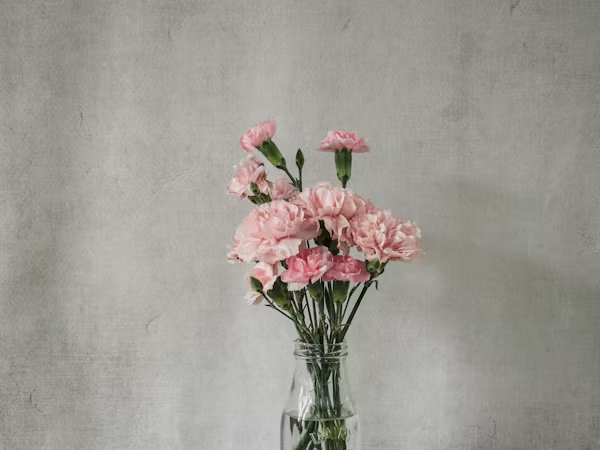
Ruffled Petal Structure: Original wild species possess five distinct petals with serrated or fringed edges. However, centuries of selective breeding produced "double-flowered" cultivars packed with dozens of overlapping, ruffled petals that create its signature dense, pom-pom texture.
Eugenol Scent Profile: The sweet, spicy aroma of carnations is driven primarily by eugenol—the same aromatic organic compound found in cloves and cinnamon.
Superior Post-Harvest Longevity: Carnations possess one of the longest vase lives among commercial cut flowers, often lasting 2 to 3 weeks after harvest if kept in clean water away from ethylene gas sources (such as ripening fruit).
3. Key Categories and Commercial Types
In floriculture, carnations are broadly categorized into three distinct market groups:
Standard (Large-Flowered) Carnations: Feature one large, single bloom per stem (often 2–3 inches across). They are the traditional choice for formal boutonnieres, corsages, and structural floral arrangements.
Spray (Miniature) Carnations: Feature multiple smaller blossoms on short lateral branches extending from a single main stem, widely used to add texture and volume to mixed bouquets.
Dwarf / Micro Carnations: Compact cultivars grown primarily as potted garden perennials or rock garden borders (Dianthus chinensis and Dianthus plumarius hybrids).
4. Global Locations and Ideal Conditions
Climatic Requirements: Carnations thrive in temperate regions with cool, bright conditions. They require full sunlight (at least 4–6 hours daily) and cool nighttime temperatures (around 50–55°F / 10–13°C) to develop strong stems and vibrant color contrast.
Soil Requirements: Prefers well-draining, fertile, slightly alkaline soil (pH 6.5–7.5). Carnations are sensitive to high humidity and waterlogged roots, which make them susceptible to fungal diseases such as stem rot and rust.
Major Production Hubs: Colombia is the world's leading exporter of standard carnations, leveraging the high-altitude, cool temperatures and strong equatorial sunlight of the Sabana de Bogotá. Other major production centers include China, Spain, Kenya, and Israel.