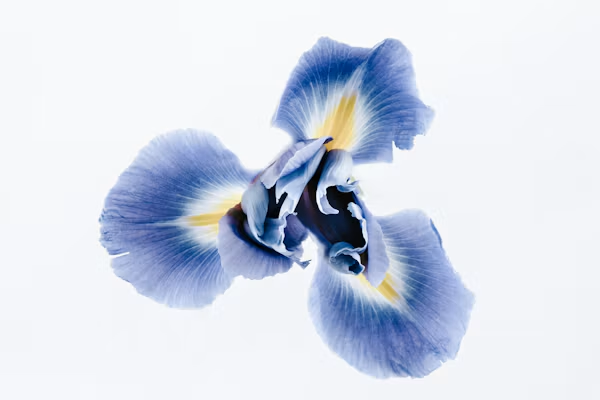
The iris (Iris) is a genus of 260–300 species of flowering plants in the family Iridaceae. Named after the Greek goddess of the rainbow, the iris is globally celebrated for its complex three-part floral architecture, deep historic symbolism in royalty and art, and diverse horticultural varieties.
1. History and Cultural Significance
Classical Mythology & Royal Emblems: In Greek mythology, Iris was the messenger goddess who traveled along rainbows to connect heaven and earth; the flower was named in her honor due to its extensive spectrum of colors. In ancient Egypt, irises were carved onto temple walls and pharaonic scepters as symbols of power and divine connection.
The Fleur-de-lis: The stylized iris design known as the fleur-de-lis became the iconic heraldic symbol of the French monarchy during the Middle Ages, representing perfection, light, and royal authority.
Artistic Inspiration & Orris Root: Irises have inspired master painters throughout history, most famously Vincent van Gogh in his Irises series. Historically, the dried rhizomes of Iris florentina and Iris pallida yield orris root, prized for centuries in traditional medicine and high-end perfumery as a fragrant fixative with a violet-like scent.
2. Botanical Structure & Floral Anatomy
Distinctive Architecture (Standards & Falls): The hallmark of an iris bloom is its unique two-tiered arrangement of six tepals:
Standards: The three inner tepals that stand upright or arch inward.
Falls: The three outer tepals that droop or spread outward and downward.
Bearded vs. Beardless Types:
Bearded Irises: Feature a fuzzy, caterpillar-like strip of soft hairs (the "beard") running down the center of each fall floret to guide pollinating insects toward nectar.
Beardless Irises: Lack hair tufts, possessing smooth falls often adorned with vivid yellow signal patches.
Growth Mechanics: Irises propagate primarily via creeping underground stems called rhizomes or, in certain species (like Dutch irises), true bulbs.
3. Key Categories and Primary Varieties
Horticulturists broadly classify irises into major cultivated groups based on root structures and floral characteristics:
Bearded Irises (Iris germanica hybrids): The classic garden iris, offering an immense array of colors and sizes—ranging from dwarf types (under 8 inches) to tall bearded varieties reaching over 3 feet in height.
Siberian Irises (Iris sibirica): Beardless, cold-hardy perennials with slender foliage and delicate, graceful blossoms that thrive in moist garden soils.
Japanese Irises (Iris ensata): Beardless varieties famous for massive, flat-topped blooms that can span up to 8 inches across, preferring boggy, acidic conditions.
Dutch Irises (Iris hollandica): Bulbous irises widely grown for cut-flower production, featuring sleek, elegant blooms on sturdy stems.
4. Global Locations and Ideal Conditions
Distribution: Native throughout temperate regions of the Northern Hemisphere, extending across Europe, Asia, North America, and North Africa.
Soil & Climate Needs: Most rhizomatous irises require full sun (at least 6 hours of direct light daily) to bloom reliably. They prefer well-draining, neutral to slightly acidic soil. When planting bearded iris rhizomes, the tops of the rhizomes should remain partially exposed to sun and air; planting them too deeply causes fungal rhizome rot.