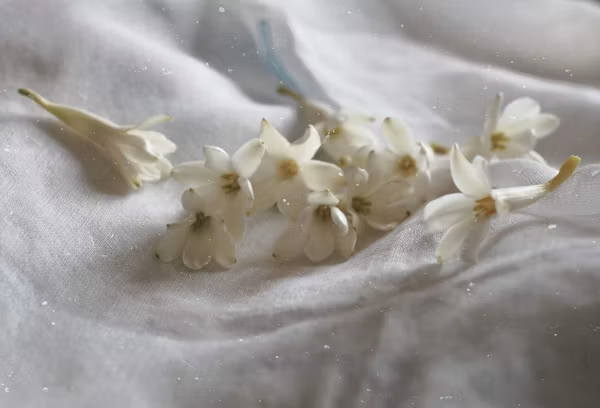
Tuberose
The Tuberose: History, Biology, and Nocturnal Fragrance
The tuberose (Agave amica, formerly classified as Polianthes tuberosa) is a night-blooming perennial plant in the asparagus family, Asparagaceae. Renowned globally for its tall spikes of waxy white blossoms and deeply intoxicating, creamy floral scent, the tuberose is one of the most prized flowers in fine perfumery, traditional South Asian floristry, and ceremonial garlands.
1. History and Cultural Significance
Mesoamerican Origins: Unlike many fragrant flowers native to the Old World, the tuberose originated in central and southern Mexico. The Aztecs cultivated the flower—known in Nahuatl as omixochitl ("bone flower," referencing its pure white, tubular blooms)—for ceremonial bouquets, medicinal remedies, and scenting chocolate beverages.
Global Arrival & Perfume Capital: Spanish explorers brought tuberose bulbs to Europe in the 16th century. By the 17th century, it became a prized luxury crop in Grasse, France, where its complex scent became a cornerstone of classical haute perfumery.
South Asian Reverence (Rajnigandha): Introduced to South Asia via trade routes, the tuberose became deeply woven into Indian and Bangladeshi culture. Known as Rajnigandha ("fragrance of the night"), its spikes and individual florets are indispensable for wedding garlands, bridal hair ornaments, religious offerings, and celebratory decor.
2. Botanical Structure & Nocturnal Scent Chemistry
Tuberous Rootstock: Despite its common name, the tuberose is not related to roses; the name derives from the Latin tuberosa, meaning "swollen" or "tuberous," referring to its thick, underground rhizome-like rootstock that stores energy and produces offsets.
Sequential Spike Blooming: The plant sends up slender, unbranched flower stalks reaching 2 to 3.5 feet (60–110 cm) tall, emerging from a basal rosette of narrow, grass-like leaves. Paired tubular blossoms open sequentially from the base of the spike upward over several weeks.
Nocturnal Pollination & Scent Profile: Tuberose flowers release their strongest perfume after dusk to attract nocturnal hawkmoths. Its rich, narcotic fragrance—often described as a blend of gardenia, jasmine, and honeyed spice—is driven by volatile compounds including methyl benzoate, benzyl benzoate, methyl salicylate, and indole. Notably, freshly cut tuberose spikes continue to emit fragrance for several days after harvest.
3. Key Cultivars and Horticultural Forms
Commercial growers and perfumers categorize tuberose cultivars primarily by petal count and floral density:
Single-Flowered Cultivars (e.g., 'Mexican Single', 'Shringar', 'Prajwal'): Produce classic, six-petaled star-shaped blossoms along sturdy spikes. Single varieties contain the highest concentration of essential oils and are preferred for commercial fragrance extraction (enfleurage and solvent extraction) and loose-flower garlands.
Double-Flowered Cultivars (e.g., 'The Pearl', 'Suvasini', 'Vaibhav'): Feature dense, rose-like blossoms packed with 20 to 30+ overlapping waxy petals. While slightly less intensely scented than single varieties, double types are prized as long-lasting cut flowers in bouquets and vases.
Variegated & Tinted Cultivars: Modern breeding has produced variegated foliage forms (such as 'Variegata' with creamy leaf margins) and soft pink- or yellow-blushed hybrids (e.g., 'Pink Sapphire').
4. Global Locations and Ideal Conditions
Climatic Requirements: Tuberose is a warm-climate perennial (USDA Zones 8–11) that thrives in tropical and subtropical conditions. It requires full sun exposure (at least 6 to 8 hours of direct sunlight daily) and warm soil temperatures above 70°F (21°C) to initiate robust spike growth.
Soil & Moisture: Prefers rich, fertile, loamy, well-draining soil with a neutral to slightly acidic pH (6.5–7.0). Consistent moisture is critical during active leaf and spike development, while waterlogged soil during winter dormancy causes bulb rot.
Major Production Hubs: Beyond historic fields in Grasse (France), major commercial cultivation thrives across India (particularly West Bengal, Karnataka, and Tamil Nadu), Bangladesh (notably Jashore), China, Egypt, and Mexico.