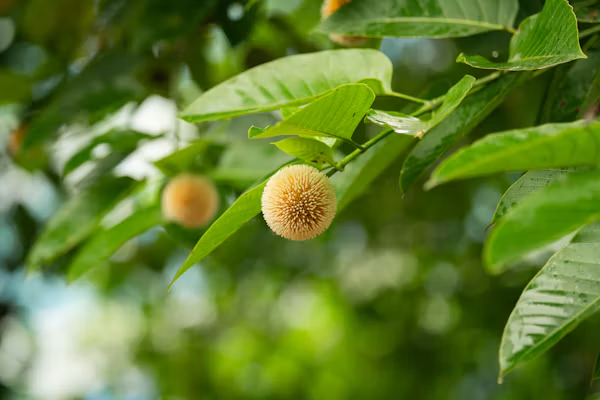
Burflower
The Burflower: History, Biology, and Monsoon Heritage
The burflower (Neolamarckia cadamba, formerly classified as Anthocephalus chinensis), widely known across South Asia as Kadam or Kodom, is a fast-growing tropical evergreen tree in the coffee and gardenia family, Rubiaceae. Famous for its spherical, pincushion-like golden-orange blossoms and sweet, rain-washed fragrance, the burflower is an iconic herald of the South Asian monsoon.
1. History and Cultural Significance
Sacred South Asian Heritage: Native to South and Southeast Asia, the burflower holds deep religious and mythological significance in Hinduism and Buddhism. In Hindu tradition, the Kadam tree is sacred to Lord Krishna, who is frequently depicted playing his flute beneath its shade in Vrindavan. The Kadamba Dynasty, which ruled parts of southern India from 345 to 525 CE, took its name directly from the tree.
Symbol of the Monsoon (Borsha): In Bengali literature, poetry, and song—most notably in the works of Rabindranath Tagore—the blooming of the Kodom flower marks the arrival of the monsoon rains, symbolizing romance, longing, and seasonal renewal.
Traditional Perfumery (Attar): For centuries, the intensely fragrant blossoms have been harvested in India and Bangladesh for hydro-distillation into a sandalwood oil base to produce traditional Kadam attar.
2. Botanical Structure & Floral Anatomy
Globular Flower Head: What appears to be a single fuzzy ball is actually a dense, spherical inflorescence (measuring about 1.5 to 2.2 inches / 4–5.5 cm in diameter) composed of hundreds of tiny, tightly packed, bisexual tubular florets attached to a central fleshy receptacle.
The "Pincushion" Effect: The individual corollas are deep yellow-orange, while the long, slender white styles and stigmas protrude outward uniformly from every floret—creating the signature spiky, white-tipped golden sphere.
Rapid Pioneer Growth: Neolamarckia cadamba is a fast-growing pioneer tree capable of reaching heights of up to 145 feet (45 meters) with a straight cylindrical trunk and tiered, horizontally spreading branches. Its large, glossy, oppositely arranged leaves feature prominent veins and drop-tips adapted for shedding heavy tropical rain.
Fleshy Syncarp Fruit: After pollination by insects and bats, the flower head develops into a small, fleshy, yellowish-orange multiple fruit containing thousands of microscopic seeds.
3. Related Species and Regional Names
While Neolamarckia cadamba is the primary cultivated species, botanists and regional traditions recognize a close relative and numerous cultural names:
Common Burflower (Neolamarckia cadamba): The widespread tropical tree known as Kodom (Bengali), Kadam (Hindi), Laran (Malay/Indonesian), and Leichhardt pine (Australia)
Macrophylla Burflower (Neolamarckia macrophylla): A closely related species native to Sulawesi and the Maluku Islands of Indonesia, distinguished by even larger leaves and slightly larger flower heads.
Ornamental & Timber Applications: Beyond its fragrant blooms, the tree's lightweight, uniform wood is commercially harvested for plywood, paper pulp, crates, and matches, while its root bark yields a natural yellow dye.
4. Global Locations and Ideal Conditions
Native Range: Naturally distributed across the Indian subcontinent (Bangladesh, India, Nepal, Sri Lanka), southern China, mainland Southeast Asia, the Malay Archipelago, Papua New Guinea, and northern Australia.
Climate Requirements: Strictly a tropical and subtropical species (USDA Zones 10–12), the burflower thrives in warm, humid climates with temperatures between 68°F and 100°F (20–38°C) and abundant annual rainfall. It is highly sensitive to frost.
Soil & Habitat: In the wild, it colonizes riverbanks, alluvial plains, and secondary rainforests. It requires full sunlight and prefers deep, moist, fertile, well-draining loamy soil, though mature trees tolerate periodic seasonal flooding.