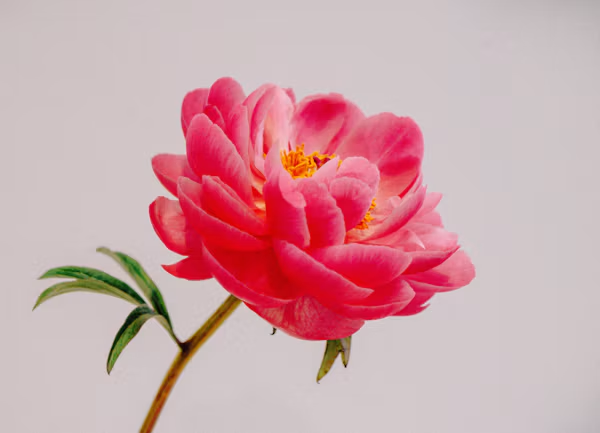
Peony
The Peony: History, Biology, and Botanical Prestige
The peony (Paeonia) is the sole genus of flowering plants in the family Paeoniaceae, comprising roughly 33 recognized wild species of herbaceous perennials and woody shrubs. Celebrated for its opulent, multi-layered blossoms, sweet rose-like fragrance, and remarkable longevity (often living for decades in a single garden spot), the peony stands as one of the world's most revered ornamental and medicinal plants.
1. History and Cultural Significance
Imperial China ("The King of Flowers"): Cultivated in China for over 2,000 years—initially for the medicinal properties of its roots and later for ornamental beauty—the tree peony (Paeonia suffruticosa) became the imperial flower during the Tang and Song dynasties. Known as Mudan ("King of Flowers"), it symbolizes wealth, honor, nobility, and prosperity across East Asian art, porcelain, and literature.
Greek Mythology & Medicinal Roots: The genus name Paeonia derives from Paeon, a physician to the Greek gods. According to myth, Paeon used a peony root to heal Hades (or Pluto) from a battle wound; when his mentor Asclepius grew jealous and plotted to kill him, Zeus saved Paeon by transforming him into the peony flower. In both ancient Greek medicine and traditional Chinese medicine (Bai Shao), peony roots were prized for treating inflammation, spasms, and circulatory ailments.
19th-Century European Breeding & Modern Floristry: Following the arrival of Chinese Paeonia lactiflora and tree peonies in Europe, 19th-century French breeders (such as Victor Lemoine) developed iconic, cold-hardy cultivars like 'Sarah Bernhardt' and 'Festiva Maxima'. Today, peonies are a premier luxury cut flower globally, especially prized in spring bridal bouquets.
2. Botanical Structure & Floral Anatomy
Storage Rootstock & Longevity: Herbaceous peonies grow from an underground crown with thick, fleshy storage roots and dormant pink "eyes" (buds) that emerge each spring. Once established, peony clumps rarely need dividing and can thrive undisturbed for 50 to 100 years.
Petal Forms & Stamen Transformation: Wild species bear single flowers with 5 to 10 outer petals surrounding a ring of golden pollen-bearing stamens and central carpels. Centuries of selective breeding transformed stamens and carpels into extra petals, yielding six primary flower forms:
Single: One or two rows of outer guard petals with a prominent center of yellow stamens.
Japanese & Anemone: Outer guard petals surrounding a central cushion of thickened, petal-like stamens (staminodes or petaloids).
Semi-Double: Multiple rows of broad petals intermixed with visible stamens
Bomb: A ring of flat outer guard petals cradling a dense, spherical central pom-pom of narrow petals.
Double: Almost all stamens and carpels are fully converted into wide, ruffled petals, creating a lush, rose-like globe.
Extrafloral Nectaries & Ants: Peony buds secrete sweet nectar from specialized glands on their outer sepals, attracting ants that feed on the sugar while defending the developing buds from sap-sucking pests. Ants are completely harmless to the plant and are not required for the buds to open.
3. Primary Horticultural Groups
Horticulturists classify cultivated peonies into three major structural categories:
Herbaceous Peonies (Paeonia lactiflora & hybrids): The classic garden peony. Woody-stemmed only at the base, they die back completely to ground level every autumn and regrow vigorously in spring. Famous cultivars include 'Sarah Bernhardt' (soft pink double), 'Coral Charm' (color-shifting coral semi-double), and 'Duchesse de Nemours' (fragrant white double).
Tree Peonies (Paeonia suffruticosa, P. rockii, P. lutea hybrids): Deciduous woody shrubs (reaching 4 to 7 feet tall) that retain their woody branches above ground through winter. They bloom earlier in spring than herbaceous types and produce massive, dinner-plate-sized blossoms up to 10 inches across.
Intersectional (Itoh) Hybrids: First achieved in 1948 by Japanese breeder Toichi Itoh by crossing herbaceous and tree peonies. Itoh peonies combine the herbaceous growth habit (dying back to the ground in winter) with the woody foliage, sturdy stems, and rare yellow, copper, and lavender flower colors of tree peonies (e.g., 'Bartzella').
4. Global Locations and Ideal Conditions
Native Range & Climate: Peonies are native to temperate regions across Asia, southern Europe, and western North America. They thrive in temperate climates (USDA Zones 3–8) because they require a prolonged winter chilling period (vernalization) below 40°F (4°C) to break dormancy and set flower buds; consequently, they do not bloom reliably in frost-free tropical climates.
Light & Soil Needs: Peonies require full sun exposure (at least 6 hours of direct sunlight daily) for strong stems and abundant blooms. They prefer deep, fertile, organic-rich, well-draining soil with a neutral to slightly acidic pH (6.5–7.0).
Critical Planting Depth: Herbaceous peony eyes must be planted shallowly—no more than 1.5 to 2 inches (4–5 cm) below the soil surface. Planting the crown too deeply is the single most common reason healthy peony bushes produce lush foliage without flowering.